![SYNTHESIS [2026]](https://irp.cdn-website.com/md/dmtmpl/eced8d17-848a-4350-a6ba-3d82737abf1b/dms3rep/multi/logo-light.svg)
How do I build E-E-A-T signals for AI search?
Did you know that 75% of top-ranking AI search results strongly depend on E-E-A-T signals? Mastering Expertise, Experience, Authority, and Trustworthiness (E-E-A-T) is crucial if you want your content to stand out and rank well in today’s AI-driven search environments. As AI systems become the norm for search engines, ensuring that your content signals these qualities is more important than ever for both visibility and credibility. In this comprehensive guide, you’ll learn step-by-step tactics to confidently build E-E-A-T signals that appeal to AI search engines and help elevate your digital presence.
Mastering E-E-A-T Signals: Why They Matter for AI Search
If you’re asking, "How do I build E-E-A-T signals for AI search?" it’s because you recognize search engines have evolved. AI-powered search engines can now evaluate signals that reflect not only high content quality but also granular details of author expertise, depth of experience, and overall trustworthiness. In the age of AI, traditional SEO must adapt—focusing solely on keywords or backlinks is not enough. AI search emphasizes trust signals, so demonstrating real expertise and authority in every blog post or AI content asset is a vital ranking factor.
Modern search engines and advanced AI systems evaluate content using E-E-A-T as primary indicators for ranking, filtering search results, and delivering AI overviews that are meaningful to users. Whether you’re optimizing a new article or updating existing blog posts, understanding and integrating E-E-A-T principles ensures your content aligns with both human and AI expectations. This not only enhances your visibility in AI search but also future-proofs your content strategy as AI-driven systems increasingly shape search results across every industry.
Understanding E-E-A-T: The Core Principles for AI Search
To truly excel in AI-driven search engines, you must grasp how each component of E-E-A-T—Expertise, Experience, Authority, and Trustworthiness—influences search outcomes. AI systems rely on E-E-A-T signals to filter content, especially when determining which blog posts or AI content answers a user’s query with the most accuracy and reliability. Search engines use these principles to assess content quality, ensuring that only authoritative and trustworthy results appear in AI search results.
What is E-E-A-T in the Context of AI Search?
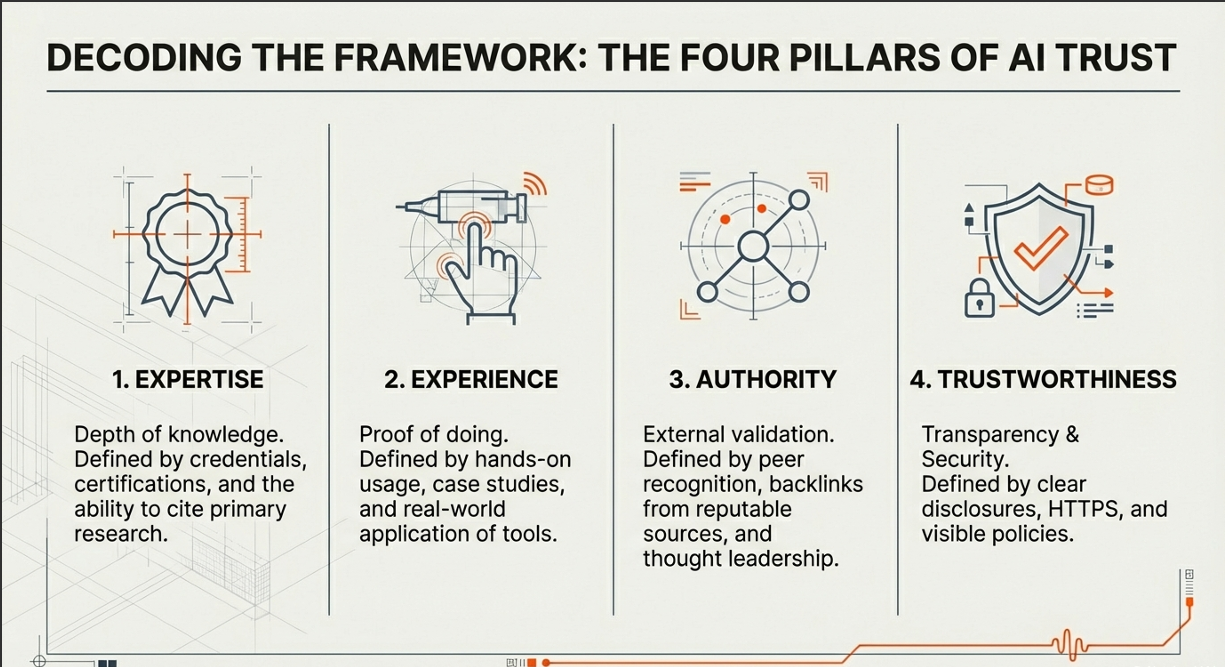
E-E-A-T stands for Expertise, Experience, Authority, and Trustworthiness. In the era of generative AI and advanced AI tools, these pillars are more than guidelines—they are technical requirements for content that seeks to thrive in AI search. For instance, expertise indicates the depth of your topic in your article or blog posts, while experience refers to demonstrable insights, such as hands-on evaluations or case studies. Authority is recognized by your standing in the field, and trustworthiness signals rely heavily on transparency and cited references, verified by schema markup and structured data across your website.
How AI Search Engines Evaluate Expertise, Experience, Authority, and Trustworthiness
AI-driven search engines and content discovery systems use multiple signals—such as the author bio, structured data, backlinks, and quality rater assessments—to determine a piece of content’s alignment with E-E-A-T. They analyze everything from the credentials displayed in your author bio to real-world user testimonials and transparent content strategies. Every credible blog post, cited source, and trust badge contributes to these signals. Modern AI tools, including those designed for SEO and content-creation optimization, help automate and validate these signals for both search engines and users, ensuring your content is recommended safely and effectively in AI-driven overviews and search results.
The Growing Role of E-E-A-T in Modern AI-Driven Search Engines
The influence of E-E-A-T signals in today’s AI search landscape cannot be overstated. With the proliferation of AI systems evaluating content, a strong E-E-A-T profile means your site and content creation efforts are far more likely to rank and remain visible in search results. AI-powered search engines favor content that radiates trust signals across every touchpoint—from schema markup to expert citations—bolstering your authority and credibility.
Generative AI and new AI tools have shifted how search quality raters assess content, pushing brands and creators to demonstrate a rigorous commitment to expertise and transparency. Leading the way in E-E-A-T signals is no longer just an option for content strategy—it’s the key to standing out and driving organic traffic in the age of AI search engines.
What You’ll Learn in This Comprehensive Guide
- How to build E-E-A-T signals for AI search step by step
- Best practices to implement E-E-A-T in AI content and blog posts
- Expert insights on the intersection of generative AI and E-E-A-T
- How to optimize for both human readers and AI systems
Key E-E-A-T Signals for AI Search: Overview Table
| E-E-A-T Element | AI Search Signal | Practical Example | Optimization Tactic |
|---|---|---|---|
| Expertise | Detailed author bios, certifications, expert sections | Author with AI credentials writing in-depth blog posts | Publish credentials, link author bios with every article, cite reputable sources |
| Experience | Case studies, testimonials, and real-user interactions | Customer stories in AI content and blog posts | Add hands-on reviews, gather and display testimonials, and use structured data |
| Authority | Backlinks from reputable sites, thought leadership articles | Peer-reviewed posts, citations from high-authority domains | Build authoritative backlinks, regularly publish thought leadership |
| Trustworthiness | Clear policies, privacy badges, transparent partnerships | HTTPS, privacy policies visible, affiliate disclosures | Display trust badges, make policies accessible, use trust-oriented schema |
Step-by-Step Guide: How Do I Build E-E-A-T Signals for AI Search?
Step 1: Demonstrate Expertise in AI Content and Blog Posts
- Showcase relevant credentials and certifications
- Cite primary research and reputable sources
- Divide content into focused, expert-led sections
Building strong E-E-A-T signals begins with showing undeniable expertise in your niche. For AI search, this means author bios must clearly display relevant credentials—degrees, certifications, or hands-on experience directly tied to AI systems or content creation. Each blog post should seamlessly integrate authoritative sources, supporting claims with peer-reviewed research or reputable academic citations. Dividing longer pieces into easy-to-navigate, expert-led sections not only enhances readability but also signals to AI tools and quality raters that your content goes deep, not just wide.
The effectiveness of your expertise signal is amplified when you make your credentials public and accessible. Don’t tuck author profiles away; instead, highlight them prominently on each blog post. In the era of generative AI and complex AI mode indexing, these practices make your content the clear choice for search engines, prioritizing reliable search results and AI overviews.
"E-E-A-T is more than a buzzword—it's the backbone of sustainable SEO in the era of AI search engines. "
Step 2: Highlight Experience within Content and AI Tools
- Include case studies and real-user testimonials in blog posts
- Share detailed author bios underscoring hands-on involvement with AI tools
- Leverage structured data to prove genuine experience
Experience is what turns expertise into actionable value. To build this E-E-A-T signal, include case studies, user testimonials, or project walkthroughs in your AI content and blog posts that showcase direct engagement with AI tools. Adding a robust author bio for each piece of content—outlining projects, speaking engagements, or recognized achievements—helps AI search systems evaluate content authenticity. Structured data (schema markup) can enhance credibility, highlight the author's experience, and link blog posts to real-world results.
Authenticity is key. Use verified case studies, snippets of user feedback, and data from AI analytics platforms to demonstrate your grasp of AI systems. Such trust signals reassure search engines and readers alike, affirming that your role in AI content is more than theoretical—it’s proven in practice.
Step 3: Establish Authority with Search Engines and AI Systems
- Acquire authoritative backlinks from established sources relevant to AI search
- Publish thought leadership blog posts and peer-reviewed articles
- Maintain a strong presence in professional AI content forums
Authority in the AI search context is earned over time—primarily through peer validation, reputable backlinks, and ongoing engagement in specialized fields. Build strategic relationships to earn backlinks from high-authority domains within the AI sector. Search engines assess your authority level by the quality and relevance of sites linking back to you, as well as mentions in forums and peer-reviewed publications. Consistently publishing thought leadership—reflecting deep dives into search engine optimization, AI mode, or technical trends—cements your place as a recognized leader in your niche.
Remember, visibility in AI search is a continuous journey. Engage in expert discussions in relevant forums and syndicate your best articles through industry networks. These combined actions reinforce your reputation with both AI systems and human quality raters, increasing your chances of ranking highly in competitive search results.
Step 4: Build Trustworthiness for Generative AI Search Environments
- Uphold transparent content strategies
- Disclose affiliations, partnerships, and sponsorships
- Showcase privacy certifications, HTTPS, and trust badges
Of all E-E-A-T components, trustworthiness is non-negotiable in the age of generative AI. Readers and AI systems alike need clear signals that your content and practices are transparent and reliable. Always disclose business partnerships, sponsorships, and affiliate relationships—transparency signals authenticity to both users and search engines. Display security certifications, enable HTTPS, and display privacy badges throughout your website to boost trust. Schema markup dedicated to privacy policies, cookie usage, and site security elevates these signals for AI systems and search engines.
Modern AI search algorithms crawl content for consistency in trust signals, routinely cross-validating public reviews and third-party accreditations with what's presented on your domain. By openly sharing your ethical standards, you not only protect your brand but also reassure algorithmic and human search quality raters about your credibility.
Leveraging Structured Data & Author Bio for AI Search E-E-A-T
Maximizing Impact with Schema Markup and Structured Data
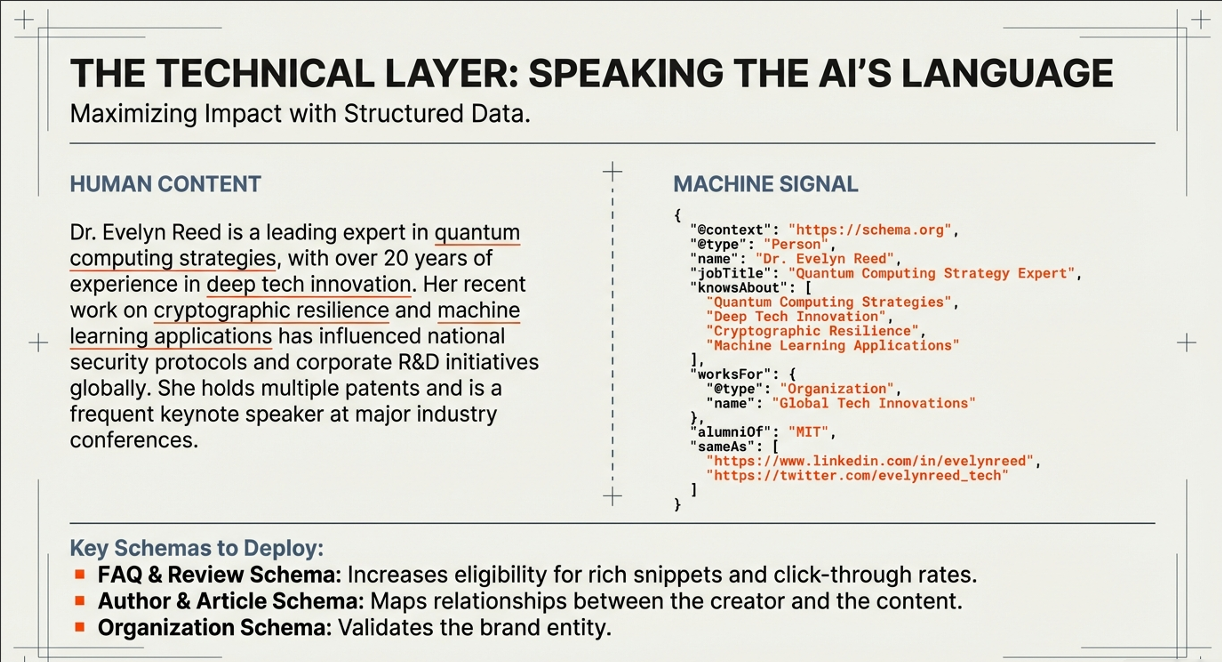
- Apply the FAQ and Review Schema for search engines
- Use the author and article schema to boost AI systems’ understanding
Structured data—especially schema markup—is a game-changer when signaling E-E-A-T elements to AI search engines. Implementing the FAQ and Review schemas can make your content eligible for rich snippets, increasing click-through rates and visibility in AI mode and standard search results. The author and article schema provide structured signals about expertise and author credentials, making it easier for AI systems and quality raters to map the relationships between your team and their published work.
For every blog post or knowledge page on your site, leverage schema markup to clarify the intent, context, and credibility of your content. The right schema does not just support AI overviews; it ultimately amplifies your brand’s trust signals across virtually every AI tool and content discovery system on the market.
Crafting Compelling and Authentic Author Bios
- Highlight a unique experience with AI tools and generative AI
- Connect author roles with ongoing content creation and strategy
Author bios are your digital handshake with both search engines and your audience. To maximize E-E-A-T signals, make each author bio both comprehensive and consistent: Include credentials, experience with AI tools, significant projects, and active roles in ongoing content creation. Connect each author to their top-performing blog posts or AI content pieces—this contextual linkage is highly valued by AI systems evaluating your authority and expertise.
Periodically update author bios to include fresh achievements or changes in content strategy. This communicates an ongoing commitment to quality and innovation, ensuring AI systems and search engines recognize your evolving edge in expertise, authority, and experience.
AI Content Optimization for Search Engines and AI Systems
Aligning AI Content with Content Strategy for E-E-A-T
- Integrate E-E-A-T signals into long-form content, tutorials, and resource hubs
- Update and audit older blog posts for improved E-E-A-T alignment
Your content strategy should ensure that every new piece of AI content or blog post prioritizes E-E-A-T signals. Start by building thorough, long-form tutorials or resource hubs where each section demonstrates expertise through cited sources, practical experience, and expert analysis. Regularly audit older content and blog posts, updating them with the latest research, structured data, and transparent author bios. Consistency across your site’s content signals trust to both users and AI systems, helping your website stay visible and credible in an ever-shifting search landscape.
Ultimately, aligning your content creation process with E-E-A-T not only improves SEO but also fosters enduring relationships with readers—an essential objective as AI-driven search engines and content discovery systems continue to evolve.
Integrating AI Tools and Generative AI in Content Creation and Strategy
Harnessing AI Mode and Generative AI for Better E-E-A-T
- Use AI tools to detect content gaps and enrich authority
- Deploy generative AI to personalize content experience
AI tools have become invaluable for both creating and optimizing high-E-E-A-T content. Modern SEO platforms use AI mode to identify content gaps, assess competitors, and recommend improvements that strengthen E-E-A-T signals. Deploying generative AI allows you to tailor blog posts and resource guides to specific user needs, boosting both engagement and perceived expertise in your content.
Human insight plus intelligent AI tools results in supercharged content creation—providing authoritative, experience-driven answers that search engines trust. Strategically using generative AI and analytics-driven AI tools gives you an edge, especially when combined with expert oversight and transparent, high-quality writing.
"Human insight plus intelligent AI tools amplifies your E-E-A-T signals more than either can alone. "
Best Practices: E-E-A-T Signals for AI Search and SEO
- Audit your brand’s representation across all AI platforms
- Monitor competitor activity in AI search and content strategy
- Regularly request and display user reviews
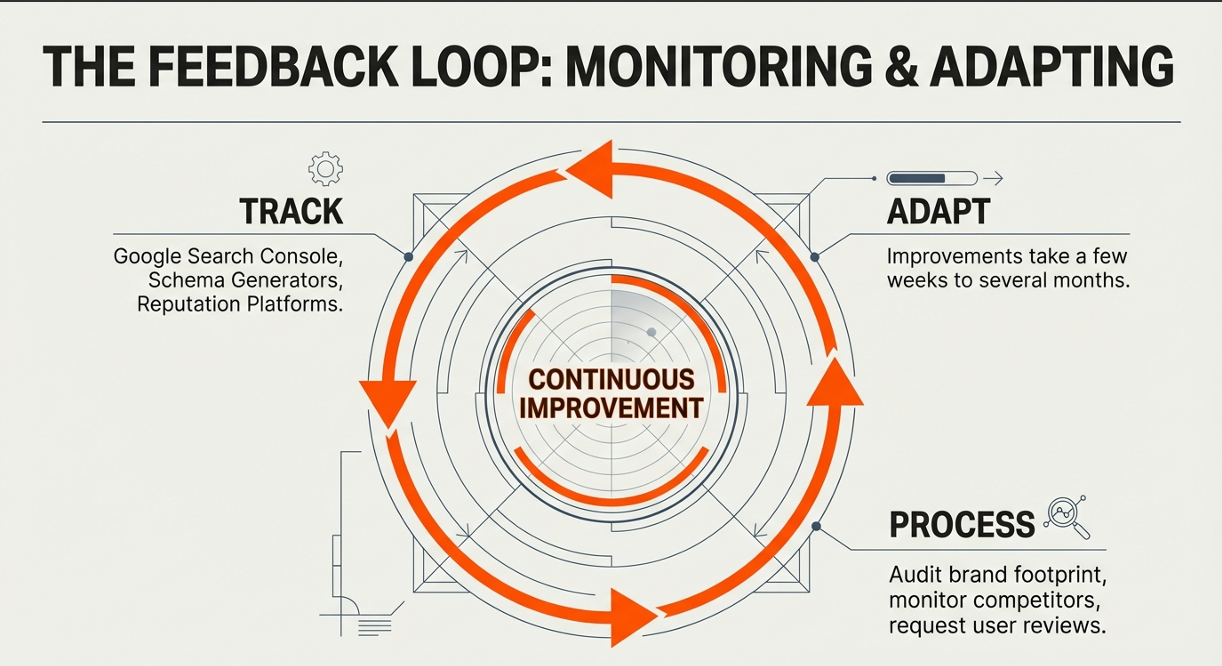
Maintaining best practices ensures you don’t just build but also sustain strong E-E-A-T signals. Start by auditing your brand and content footprint across every major AI search platform—does your presence consistently reflect transparency, expertise, and authority? Monitor how competitors evolve their content strategy, especially those ranking high in AI search, and consider their approaches to AI tools, structured data, and trust signals. Consistently request and showcase real user reviews, which double as authentic, AI-validated experience signals for both search engines and quality raters. This ongoing, proactive approach is what keeps your E-E-A-T signals powerful and future-ready.
Dynamic explainer video visually demonstrating E-E-A-T implementation in AI-driven search results and website content. Showcases key principles, real-world examples, and easy-to-follow workflows for optimizing E-E-A-T signals.
Demonstration of E-E-A-T Implementation in Real-World AI Content
Watch the step-by-step process of integrating credentials in author bios, embedding structured data, and using AI mode to enhance content authority. See real examples from AI content creators who boosted search engine rankings by following the E-E-A-T blueprint. These workflows are essential for any organization or individual aiming to excel in the age of AI-powered SEO.
Ongoing Optimization and Monitoring for AI Search E-E-A-T Signals
- Set up Google Search Console and AI analytics tools
- Implement real-time feedback loops for continual improvement
Continual E-E-A-T optimization is mandatory as search algorithms and AI systems evolve. Regularly track your rankings, E-E-A-T signals, and user feedback using Google Search Console, AI-powered SEO analysis tools, and analytics dashboards. Implement a feedback loop by monitoring shifts in search results, reviewing quality rater reports, and acting quickly on data-driven insights. This ensures your content creation and strategy always align with best practices and maximizes your visibility in AI search environments.
People Also Ask: Common Questions about How to Build E-E-A-T Signals for AI Search
What are some examples of E-E-A-T signals in AI search?
Answer: E-E-A-T signals in AI search include expert author bios, high-quality references, structured data, and consistent brand authority across multiple platforms.
How fast do E-E-A-T improvements impact AI search rankings?
Answer: The impact timeline varies, but improvements can show results in a few weeks to several months, depending on industry competition and search engine algorithms.
Do I need to use generative AI to improve E-E-A-T signals for AI search?
Answer: Generative AI is helpful but not required—the focus should be on producing high-quality, well-cited, and transparent content.
Lists of Effective Tools to Track and Boost E-E-A-T in AI Search
- Google Search Console
- Schema.org Markup Generators
- AI-powered SEO analysis tools
- Reputation management platforms
Key Takeaways: Building E-E-A-T Signals for AI Search
- E-E-A-T is essential to thrive in AI-driven search engines
- A systematic, content-led approach reinforces trust and visibility
- Combining generative AI and expert oversight is optimal for future success
Frequently Asked Questions (FAQs) About E-E-A-T and AI Search
Can E-E-A-T signals boost both AI search and traditional search engine rankings?
Yes, strong E-E-A-T signals improve rankings in both AI-driven and traditional search engines. They help establish your brand’s credibility, making your site the go-to resource in your industry.
Which structured data types support E-E-A-T optimization for AI systems?
Author, Article, FAQ, Review, and Organization schemas are most effective. These help AI systems quickly understand your content’s credibility, expertise, and trustworthy signals.
How often should I update E-E-A-T signals in content for AI search?
Regular audits are recommended—quarterly or after every major industry change. Keeping author bios, citations, and structured data up to date will ensure your E-E-A-T signals remain strong and relevant.
Conclusion: E-E-A-T Signals for Lasting Success in AI Search
Next Steps: Elevate Your E-E-A-T for AI Search
Implement strategies from this guide, continually monitor your results, and refine your E-E-A-T signals to secure lasting visibility and trust in AI-powered search environments.
Contact us at SytectAi.com
Sources
- Google Search Central: E-E-A-T – https://developers.google.com/search/docs/fundamentals/e-e-a-t
- SEJ – E-E-A-T Guidelines – https://www.searchenginejournal.com/e-e-a-t-guidelines/470961/
- Moz – What Is E-E-A-T & Why It Matters – https://moz.com/learn/seo/eeat
Recent Posts